Brand repositioning: when it pays off and what it changes beyond a rebrand
Repositioning changes the place a company holds in the market's mind. See when it pays off, how to check it and what the MovingBox case shows.
If your last budget increase did not lower the cost per customer, the problem may be distribution or it may be clarity. Five questions, one per minute, tell you which, with a score and the next steps for each zone.
Which tasks you can delegate to ChatGPT and how to check the results before use. A three-question test, cases where companies answered for AI mistakes, and how we divide the work between people and AI.
A B2B sales funnel built as a single funnel only works for the few buyers who are ready to buy right now. The double funnel separates market memory from the commercial decision and joins them at one point, designed by both teams.
Market segmentation can stop at a list of categories. Its value emerges when a company chooses which segments to prioritise. The STP model, applied to real Romanian companies, with public financial and population data.
How to use PESTEL analysis to review your company's plan and budget. The six factors for Romania in October 2026, with INS, BNR, Eurostat and European Commission data and a worked example for a manufacturer in Brașov.
How long would a rival need to copy your advantage? We use six months as a practical reference for assessing durability, using three Romanian companies, their ANAF financial statements and the limits of interpreting those results.
A unique selling proposition connects a meaningful benefit for buyers with an evidence-backed difference. How we check those conditions in Romanian company messaging, and the limits of the competitor test used in 18 audits.
When important decisions still pass through the founder, growth can slow even when demand exists. How to spot the bottleneck, write decision criteria and decide what the team can take over.
Generative engine optimization aims to make company information easier to find and cite in AI answers. We measured which bots requested files from our sites and explain what those observations can support.
A pricing strategy connects your costs, the buyer's alternatives and the benefit you can prove. We calculate how a discount affects margin and show what to check before asking for a higher price.
Romania went through 2 quarters of GDP decline and reached stagnation in the summer of 2026. The official figures on industry, consumption, wages, distribution, cars and construction, with their charts, and what a company does in a contracting market.
The 4Ps, meaning product, price, place and promotion, show what decisions a company makes. The reason a customer chooses it is decided before them. When the mix looks like the competition's, the customer compares on price. How to check that on your own company.
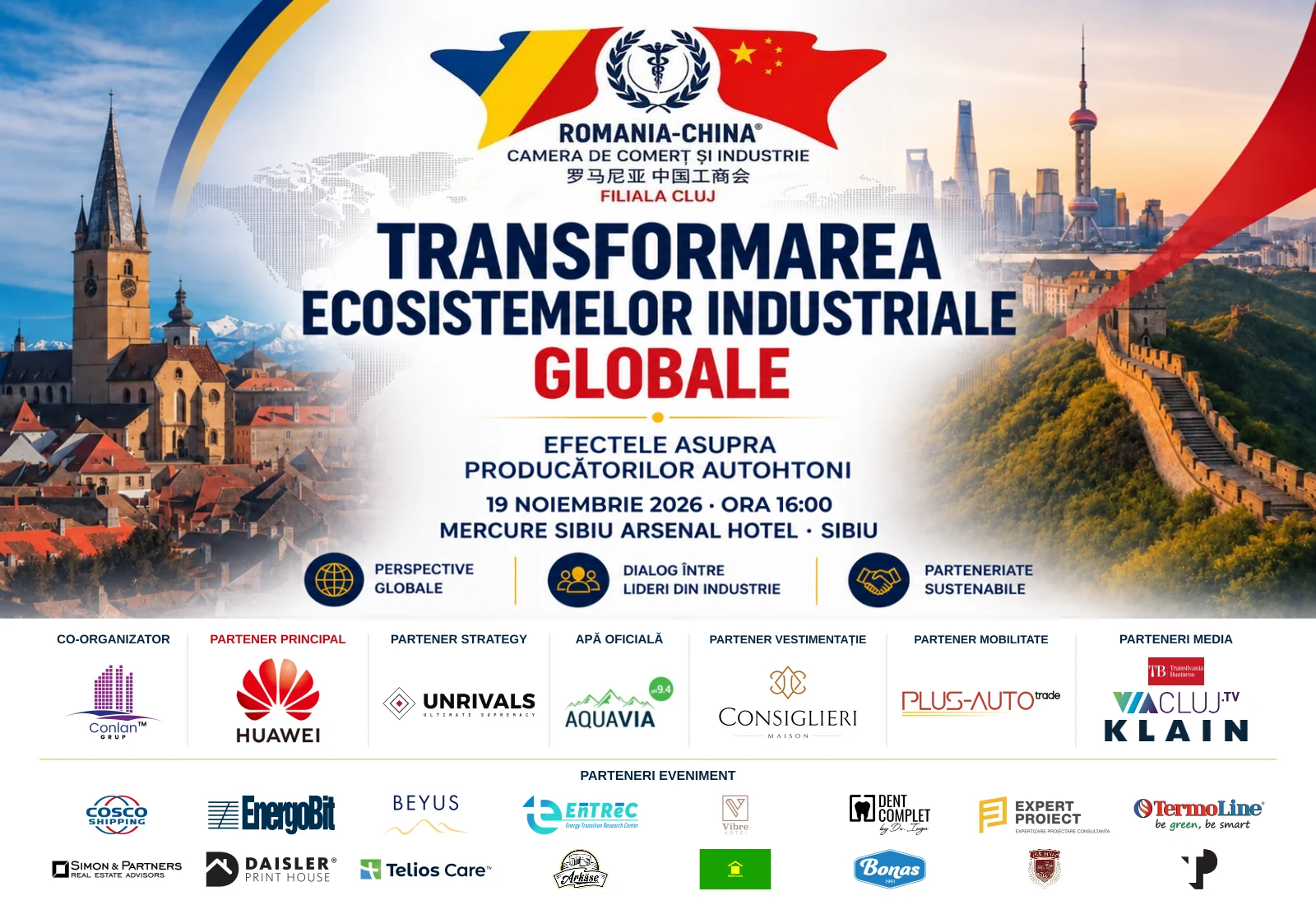
On 19 November 2026, in Sibiu, the forum “Transformation of Global Industrial Ecosystems” looks at what the reorganization of value chains means for Romanian manufacturers. UNRIVALS is the forum's business audit and strategy partner.
A new factory gets approved with a feasibility study, while the marketing that has to sell its output usually gets approved as a new website and a few campaigns. Why production capacity doesn't sell itself, and which line is missing from the investment plan.
A clearer brand should produce more than a better identity. See how positioning reaches qualification, the sales script, the offer and follow-up, and how the shift is measured through the sales cycle and win rate.
A bigger marketing budget amplifies the foundation it finds. On a broken foundation, extra money raises the price of the ceiling instead of breaking through it. How to see which link in the chain is losing the money, and when it actually pays to raise the budget.
The marketing mix is the map on which strategy gets executed. In a B2B company, part of the 4Ps is decided by the manufacturer, the importer or the channel. How to find out which decisions are yours, and how to build the mix around them.
Tesla, BYD and Mercedes-Benz had attributable profit-to-group-revenue ratios near 4% in 2025. We compare deliveries and brand valuations, with the limits of each figure.
A marketing strategy is the set of decisions that establishes which real advantage you build on, what you want to be known for, and in what order the budget gets spent. It is not the channel plan, and the difference shows up in acquisition cost twelve months later.
The company produces one thing. The buyer buys another. Seven cold call case studies show how positioning reaches the first ten seconds of a call, through SPANCO UNRIVALS™.
A fractional CMO rents your company a few days a month of a senior marketer's judgement. A growth partner writes down and hands over the infrastructure that stays after the engagement ends, and that is where the two models finally part ways.
A brand platform is not the page with a mission, a vision and five convenient values. It is the decision system that connects the reality of your business to the criterion your market chooses you on. A complete guide, from diagnosis through to measurement.
A reBranding never starts from a blank page. It starts inside a company that already has a name, products, customers, reputation and a place in the market's memory.
AI use is expanding, but its value needs a separate measure. What role should AI play inside a company, and how can you assess its results?
An AI Brain organises company information, procedures and checks so that the team and AI models work from the same context. See how one is built and what we learned from using ours.
A five-stage diagram cannot capture every return and blockage in a B2B purchase. Buyer research shows how decisions develop and what needs checking separately in less digitised markets.
An ICP describes a suitable company. A persona or avatar describes roles in the buying group; the difference between them is mainly how the profile is researched.
A cold email earns a reply when it says something true and verifiable about the recipient's company. Our method step by step, the market benchmarks with their sources, and where European consent law splits by country.
A B2B sales system is not a sales team plus a few campaigns. It is the double funnel, in which marketing builds the context and sales closes, each accountable for something measurable.
The perception of your company already exists, assembled from fragments you did not choose. The question is not whether the market holds an opinion, but who wrote it: you or chance.
Brand positioning is not a creative exercise. It is the decision about what you stop selling and who you stop selling to. It is judged in margin and sales-cycle length, not in a creative review.
The Golden Circle says you start with WHY rather than with what you sell. The model is sound, but almost every example that explains it is a billion-dollar company. Here is what it looks like on a five-million-euro one.
A SWOT analysis is a four-box table that organises what you already know about your company. The problem is not the tool. It is that most companies fill it in to feel good rather than to decide anything.
Agency or in-house team? The question assumes you are picking between two ways of buying execution. The decision that moves results comes earlier, when you settle who owns the strategy, where the company keeps its memory and in what order the budget gets spent.
*Cognitive ownership* is the position a company occupies in a buyer's mind when they think about a specific problem. It is less about how well known you are and more about what you activate in the customer's mind at the moment the need arises.
A portfolio shows what a branding agency delivered for others. The criterion that decides is the layer it works on, and this guide shows how to test it before you sign, with published price bands and our own positioning analyses of real companies.
Since 2 August 2026, the EU AI Act requires a label on photorealistic AI visuals and on public-interest text published without human review. What the law says, paragraph by paragraph, and what compliance looks like inside a production system that uses AI every day.
Huawei and BYD control several layers of the economy at once, from digital infrastructure to batteries and markets. For manufacturers in Romania and across Central Europe, the question is what position they hold in value chains that are being rewritten, and how they move from cost supplier to system partner.
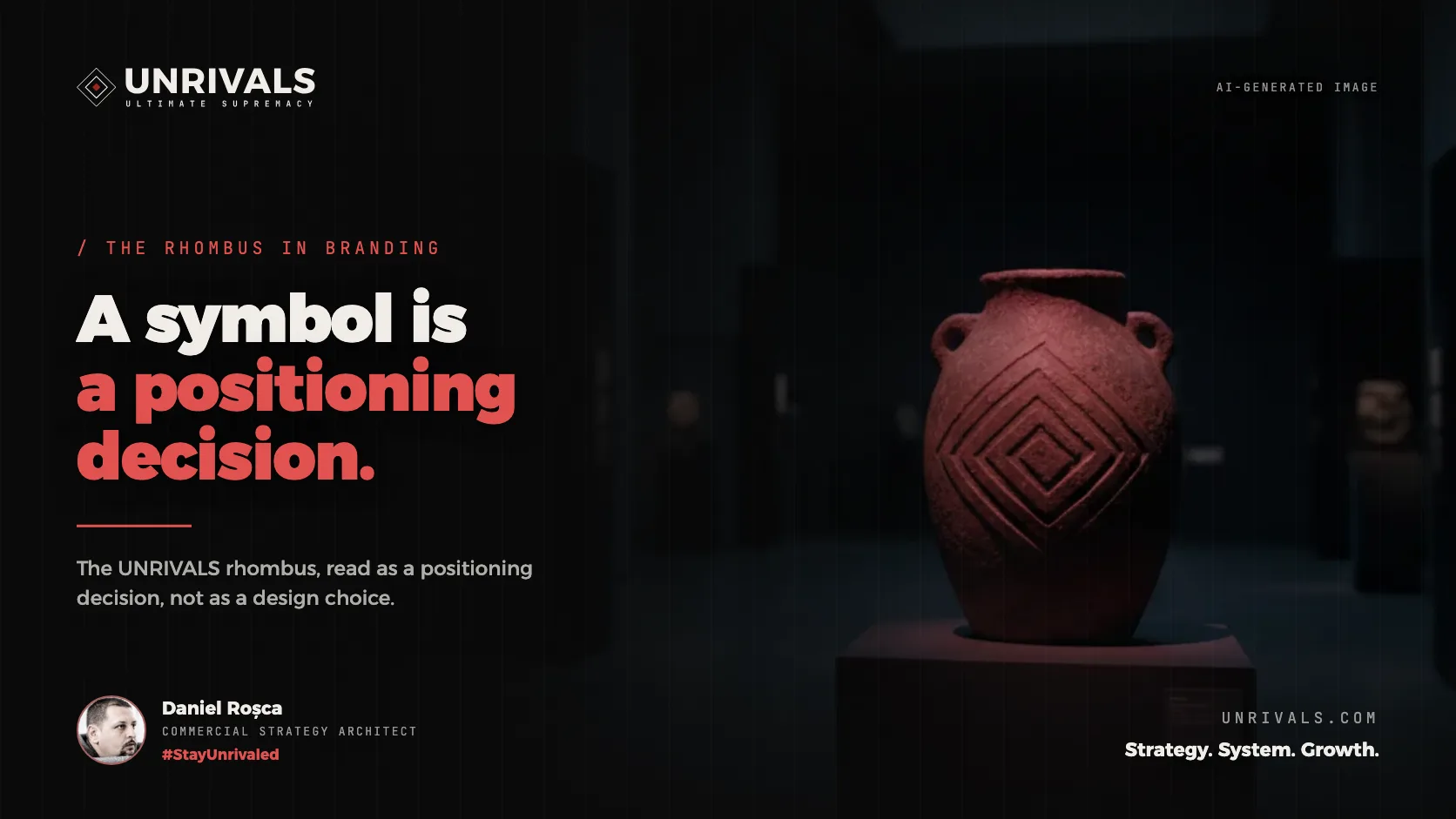
Why excellent companies end up competing on price while others get to define the whole category. The UNRIVALS rhombus, read as a positioning decision rather than a design preference.
Marketing AI puts artificial intelligence to work on a strategy that already exists. What the system looks like across four areas, which layer of the company it runs on, and what we found running it on real companies.
Isolated campaigns plateau because they do not compound. A marketing architecture connects positioning, demand, sales, and performance measurement into a system where growth accumulates month over month.
B2B branding isn't aesthetics. It's the architecture of perception, and, in the end, a mechanism of economic efficiency.
If you negotiate price on every deal, the market is not telling you that you are expensive. It is telling you it sees no other criterion to choose you by.